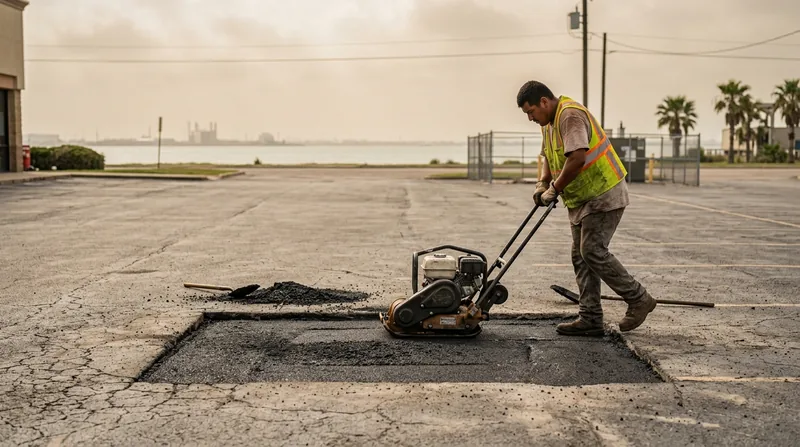




Corpus Christi parking lots face a hard fight against the Gulf Coast climate. The dark expansive clay that underlies most of the city swells when Gulf humidity soaks it, then cracks hard during dry spells, working the edges of asphalt loose and opening up alligator cracking across older surfaces. Add salt air, constant UV, and hurricane season storm surge from June through November, and even a well-built lot develops potholes, edge failures, and surface breakup faster than most inland Texas cities. Parking Lot Repair & Resurfacing in Corpus Christi means cutting out the failed sections, rebuilding the base to shed water properly, and patching or resurfacing flush so the repair holds through the next storm season. We've been doing this work since 2014, and we know exactly how Corpus Christi's terrain and weather attack a parking lot.
Why Parking Lot Repair & Resurfacing Matters in Corpus Christi
A parking lot in Corpus Christi doesn't fail all at once. It starts with small potholes where water pools on the flat coastal plain and breaks the bond between asphalt and base. The clay underneath swells and shrinks with every humid spell and dry period, working the edges loose. Over time, alligator cracking spreads across the surface, a sign that the base course has lost its compaction or the asphalt is flexing too much under load. Ignoring these early signs is expensive: a small pothole costs $150 to $300 to patch properly, but a lot that's gone thirty to forty percent failed needs a full resurfacing, which runs much higher. The key is catching the damage early and deciding whether to patch, resurface, or replace.
- Potholes in Corpus Christi form fast because water sits on flat ground and the clay base swells underneath, breaking the asphalt bond.
- Alligator cracking spreads from the center outward when the base loses compaction or the asphalt layer is too thin for the load.
- Salt air and UV accelerate edge failure and surface oxidation, especially on older lots that have not been sealed or maintained.
- Hurricane season storms pond water on the lot and chew up edges where drainage is poor or the pitch is inadequate.
- Patching holds best when the failed area is small and isolated; extensive cracking or more than thirty to forty percent surface failure calls for resurfacing or replacement.
Catching the problem early and making the right repair choice saves money and keeps your lot safe and durable.
Key info: Corpus Christi parking lots sit on dark expansive clay that swells and shrinks with humidity and drought. This cycle works asphalt edges loose and opens cracks faster than in inland Texas. Pitch and drainage matter more than grade here because water doesn't naturally run off a flat lot. Proper base preparation and slope toward catch basins or perimeter swales are the difference between a lot that lasts and one that fails in five years.
For more on how asphalt fails and what repair looks like, see our page on Pothole Repair & Asphalt Patching.
How We Repair and Resurface Parking Lots in Corpus Christi
Our process starts with a site visit to measure the lot, identify failed areas, and test the base course. We map out which sections are worth patching and which need resurfacing or full-depth replacement. For a small pothole or edge failure, we cut out the bad asphalt, inspect and repair the base if needed, and patch flush with new hot mix asphalt. For extensive cracking or a lot that's lost more than thirty to forty percent of its surface, we recommend a full resurfacing: we mill off the top course, inspect the base, add a new binder and surface course, and compact it to spec. We always provide a written estimate with tonnage and thickness so you know exactly what you're getting.
- We measure the lot and inspect the base course to determine whether patching or resurfacing makes sense.
- For small potholes or edge failures, we cut out the failed asphalt, repair the base, and patch flush with new hot mix.
- For extensive cracking or more than thirty to forty percent surface failure, we mill the top course and apply a new binder and surface layer.
- We proof roll the base after repair to confirm compaction, and we use tack coat between layers so the new asphalt bonds properly.
- We provide a written estimate with tonnage and thickness specs so you have proof of what was delivered and installed.
The result is a parking lot that sheds water properly, resists the clay's swell-shrink cycle, and holds up through the next hurricane season.
Real example: A retail lot in south Corpus Christi near Flour Bluff had potholes forming along the north edge where water pooled. We cut out a 200-square-foot section, found the base was soft and holding moisture, rebuilt it with compacted aggregate, and patched with 2 inches of new hot mix. The repair cost $1,200 and bought the lot three more years. Without it, the cracking would have spread and forced a full resurfacing at $8,000 to $12,000.
For a deeper look at resurfacing versus replacement, see Asphalt Resurfacing & Overlay.
Repair Methods and When to Use Each
| Approach | Description | Best for |
|---|---|---|
| Pothole Patching | Cut out the failed asphalt, inspect and compact the base, and fill with new hot mix asphalt, compacted and leveled flush. | Small isolated potholes or edge failures in an otherwise sound lot. |
| Full-Depth Patching | Remove asphalt and base down to subgrade, rebuild the base course with compacted aggregate, and install new asphalt from bottom up. | Sections where the base has failed, swelled, or is holding water and causing repeated pothole formation. |
| Mill and Overlay | Remove the top 1.5 to 2 inches of asphalt, inspect the base, and apply a new binder and surface course over the existing base. | Lots with alligator cracking or oxidized surface but a solid base; extends life 7 to 10 years at lower cost than full replacement. |
| Full Resurfacing | Mill off the entire asphalt surface, inspect and repair the base as needed, and install new binder and surface courses to spec. | Lots with extensive cracking, more than thirty to forty percent failed area, or multiple pothole repairs that did not hold. |
Parking Lot Repair & Resurfacing Cost in Corpus Christi: What to Expect
Parking lot repair pricing depends on the scope and the condition of the base course. A single pothole patch runs $150 to $400, depending on size and depth. A larger edge repair or a 500-square-foot section of full-depth patching starts at $650 to $900. A mill and overlay over a sound base runs $3 to $5 per square foot, so a 5,000-square-foot lot costs $15,000 to $25,000. A full resurfacing with base repair can run $4 to $7 per square foot depending on how much base work is needed. The biggest variable is the condition of the base: if the clay underneath has swelled or the aggregate has lost compaction, we rebuild it, and that adds cost. If the base is solid, we can overlay and save money.
The best way to know the real cost is to get a site estimate. We measure the lot, probe the base, and provide a written quote with tonnage and thickness so you see exactly what you're paying for. Small repairs can often be done in a day; resurfacing a large lot may take two to three days depending on size and weather.
Cost factors: A pothole in clay-heavy soil like Corpus Christi costs more to repair right because we must inspect and often rebuild the base. A parking lot on soft or swelling clay costs more to resurface because the base may need rework. Lots with good drainage and solid base cost less because we can overlay without deep repairs. Salt air and UV damage the surface faster here, so older lots may need full resurfacing rather than a patch job.
For a full breakdown of what we charge across all services, see our pricing page.
Parking Lot Repair & Resurfacing Near Me: What to Look for When Hiring a Contractor in Corpus Christi
Hiring the right asphalt contractor is as important as the repair itself. Start by asking any contractor for proof of insurance and a written estimate with tonnage and thickness on it. Check references from recent parking lot work in Corpus Christi, Portland, Rockport, or nearby areas. Verify that the contractor is local and has been in business long enough to understand how Corpus Christi's clay and Gulf climate affect asphalt. Permitting rules vary by city and by HOA, so ask whether your lot requires a permit and whether the contractor has pulled permits in your jurisdiction before. Get at least two or three estimates so you can compare scope and price.
- Ask for proof of insurance and a written estimate that includes tonnage, thickness, and the scope of base repair if any.
- Check references from recent parking lot repair or resurfacing work in Corpus Christi or the surrounding area.
- Verify that the contractor is local, has been in business for several years, and understands Corpus Christi's soil and climate challenges.
- Confirm whether your lot requires a permit and whether the contractor has experience pulling permits in your city or HOA.
- Get multiple estimates so you can compare the scope of work, the materials, and the price before you decide.
Beware of unsolicited door-to-door offers, large cash deposits, no written contract, or prices that seem too good to be true. The strongest sign of a trustworthy contractor is one who is verifiably local, provides a written estimate with specs, and is willing to answer your questions about the work.
Ready to get started? Contact us for a free estimate at (361) 371-4726. We'll measure your lot, inspect the base, and give you a realistic quote with no obligation to book.
Parking Lot Repair & Resurfacing in Corpus Christi: Pricing Guide
| Service | Price | Details |
|---|---|---|
| Pothole Patching | Starting at $150 | Single pothole or small edge failure, cut and filled flush with new hot mix asphalt, compacted to spec |
| Full-Depth Section Repair | Starting at $650 | 500 to 1,000 square feet, includes base inspection and rebuild if needed, new asphalt from subgrade up |
| Mill and Overlay | From $3 to $5 per square foot | Remove top course, inspect base, apply new binder and surface; cost varies with base condition and extent of repairs |
| Full Resurfacing | From $4 to $7 per square foot | Complete surface removal, base repair if needed, new asphalt installed to thickness spec; larger lots and clay base work cost more |
| Estimate and Site Visit | Free | We measure, probe the base, and provide a written quote with tonnage and thickness within 24 hours |
Indicative pricing, the exact cost depends on square footage, finish, and site access. Free personalized estimate within 24h at (361) 371-4726.


